
About ISO
Practical solutions to real-world problems
The International Organization for Standardization (IOS) brings together global experts to agree on the best ways to do things – from making products to managing processes – by publishing standards called ISO Standards. As one of the oldest non-governmental international organizations, ISO has been facilitating trade and cooperation between individuals and businesses worldwide since 1946. ISO standards aim to make life easier, safer, and better.

Many languages, one name: ISO
Because “International Organization for Standardization” has different acronyms in different languages (e.g., IOS in English, OIN in French for Organisation Internationale de Normalisation), the founders chose the name “ISO” from the Greek word “isos,” meaning “equal.”
ISO Central Secretariat
Chemin de Blandonnet 8
CP 401
1214 Vernier (Geneva)
Switzerland
Email: central@iso.org
Tel.: +41 22 749 01 11
26
International Standards and other results covering almost all aspects.
174
Members who represent ISO in their country. There is only one member per country.
87
Technical committees and subcommittees to manage the development of standards.








Journey & history
-
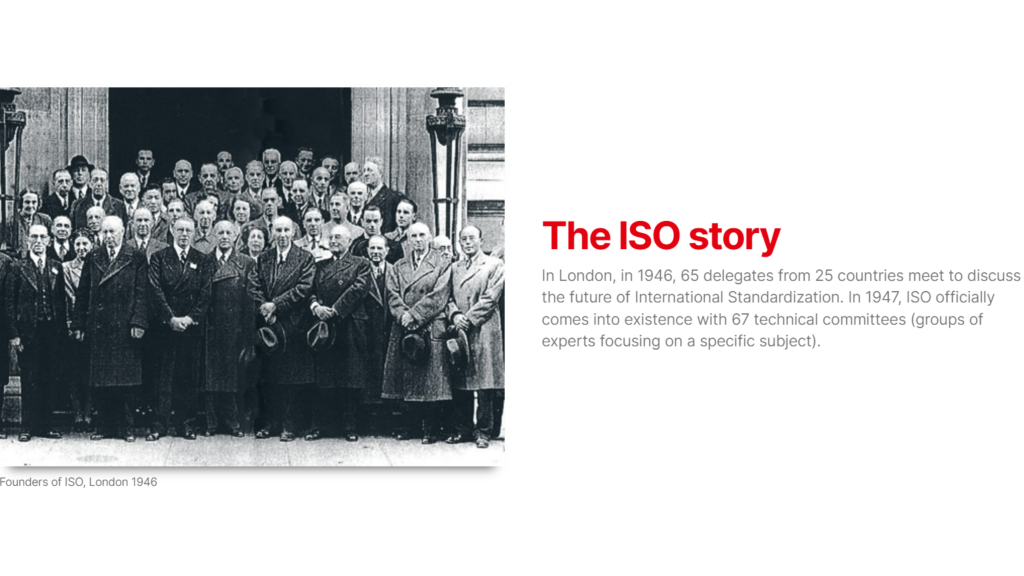
1946
History of ISO
In London, in 1946, 65 delegates from 25 countries met to discuss the future of International Standardization. In 1947, ISO was officially established with 67 technical committees (groups of experts focused on specific subjects).
-
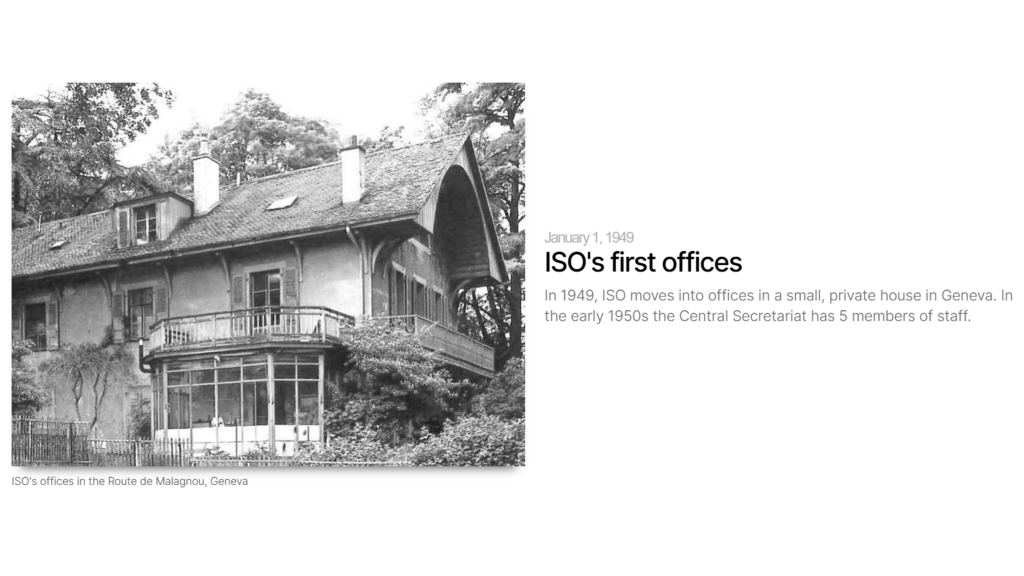
1949
ISO's First Office
In 1949 (January 1, 1949), ISO moved to offices in a small private home in Geneva. By the early 1950s, the Central Secretariat had five staff members.
-
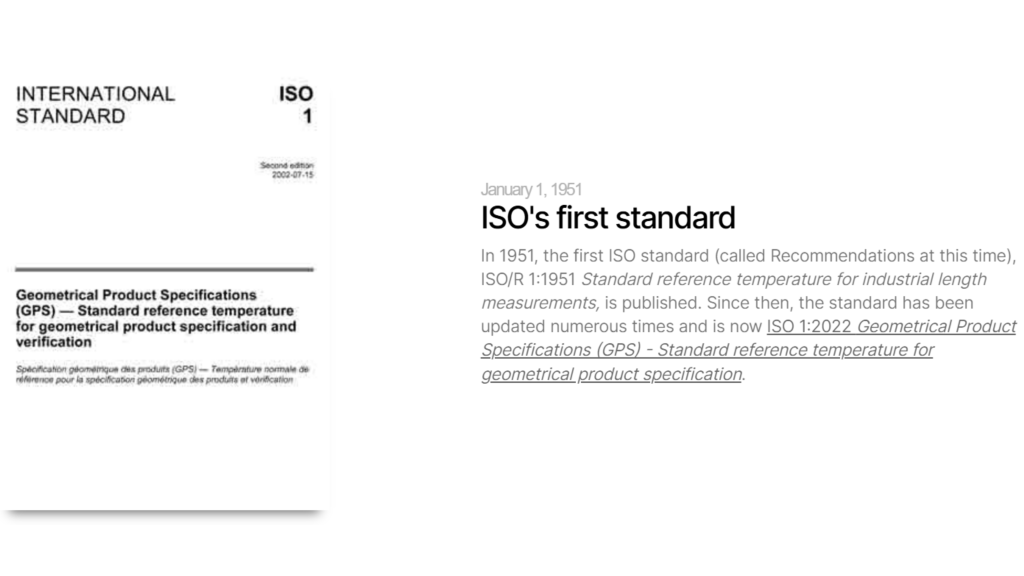
1951
ISO's First Standard
In 1951 (January 1, 1951), the first ISO standard (then called Recommendation), ISO/R 1:1951 Standard Reference Temperatures for Industrial Length Measurements, was published. Since then, the standard has been updated several times and is now ISO 1:2016 Geometric Product Specification (GPS) - Standard Reference Temperatures for Geometric Product Specifications.
-
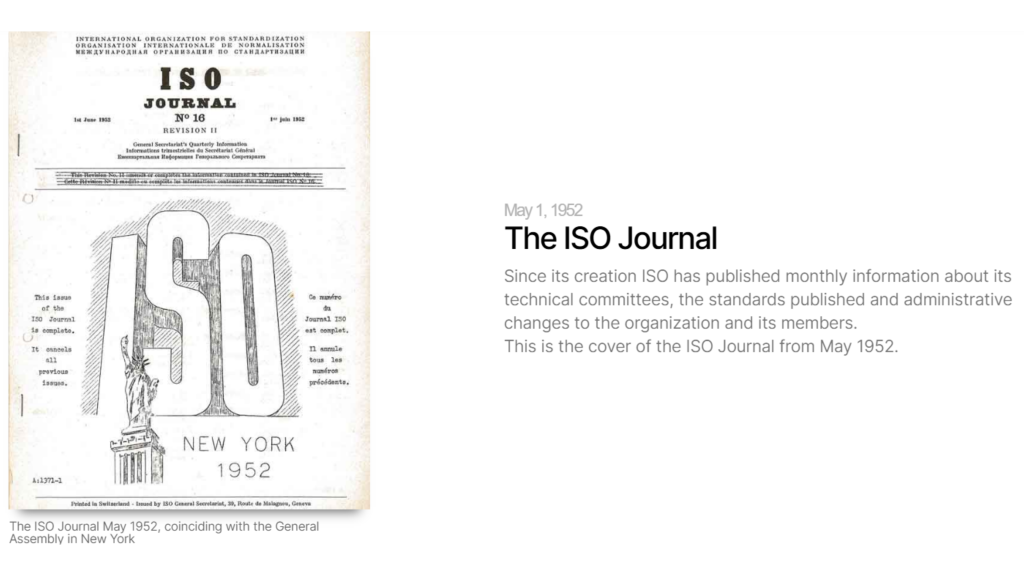
1952
ISO Journal
Since its founding, ISO has published monthly information on its technical committees, published standards, and administrative changes made to the organization and its members. This is the cover of the ISO Journal from May 1952 (May 1, 1952).
-
1955
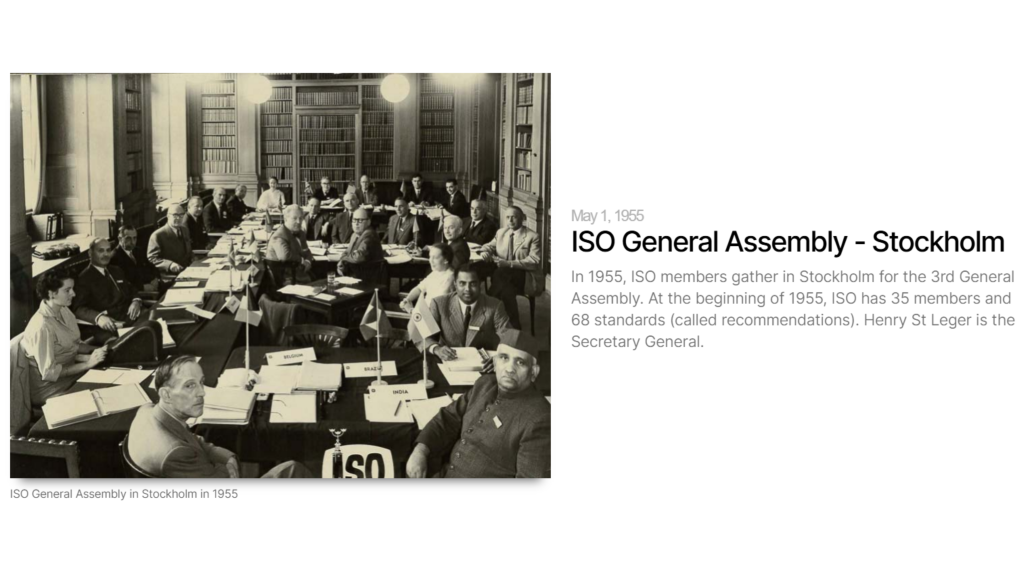
ISO General Assembly - Stockholm
In 1955 (May 1, 1955), ISO members gathered in Stockholm for the 3rd General Assembly. By the beginning of 1955, ISO had 35 members and 68 standards (called recommendations). Henry St. Leger served as Secretary-General.
-
1960
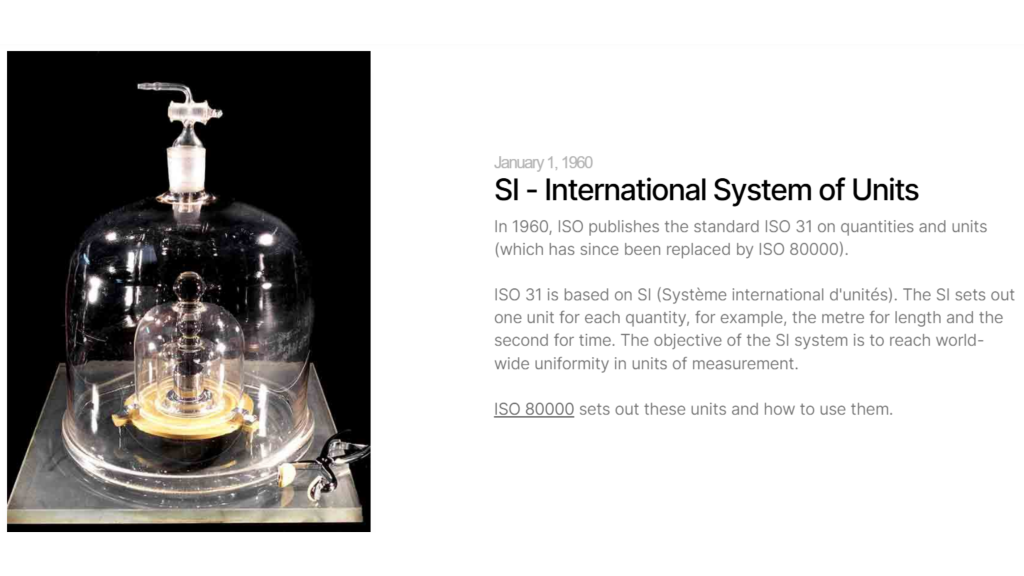
SI - International System of Units
In 1960 (January 1, 1960), ISO published the ISO 31 standard on quantities and units (later superseded by ISO 80000).
ISO 31 was based on the SI (Système international d'unités). The SI established a single unit for each quantity, for example, the meter for length and the meter for time. The goal of the SI system was to achieve uniformity of units of measurement worldwide.
ISO 80000 defined these units and how they should be used. -
1961
1960s - ISO and developing countries
During the 1960s, ISO sought to involve more developing countries in its international standardization activities.
In 1961 (January 1, 1961), ISO established DEVCO, a committee for developing countries, and in 1968 introduced Correspondent membership. This allows developing countries to obtain information about International Standardization activities without incurring the full cost of ISO membership.
Correspondent membership remains a popular option for many countries today. As of early 2012, ISO had 49 correspondent members. Learn more about ISO and developing countries. -
1968
Shipping containers
In 1968 (January 1, 1968), ISO published its first standard for freight containers. Transport and packaging is one area in which ISO has played an active role, transforming the way goods are shipped around the world.
Learn more about standards related to freight containers. -
1969
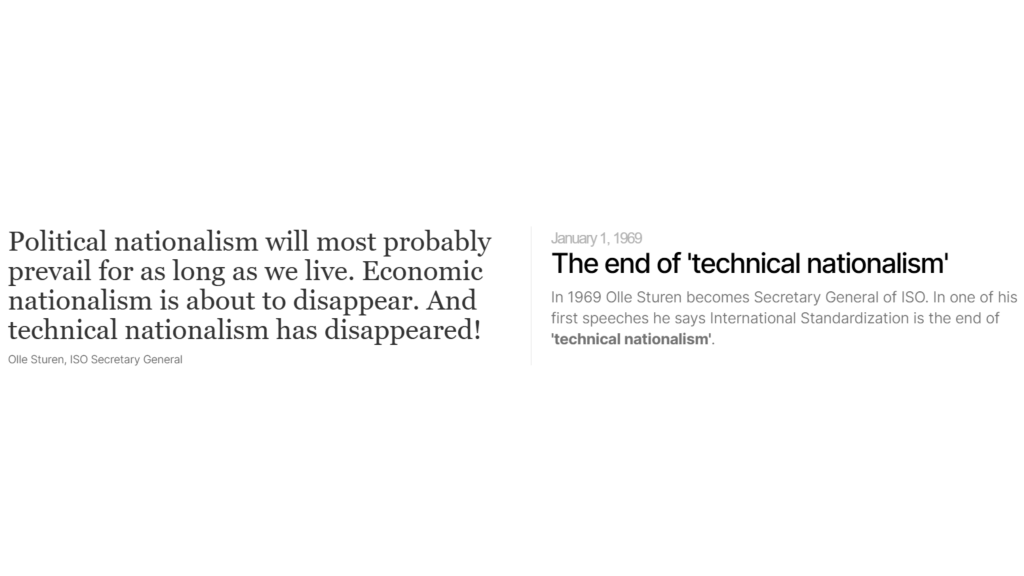
The End of 'Technical Nationalism'
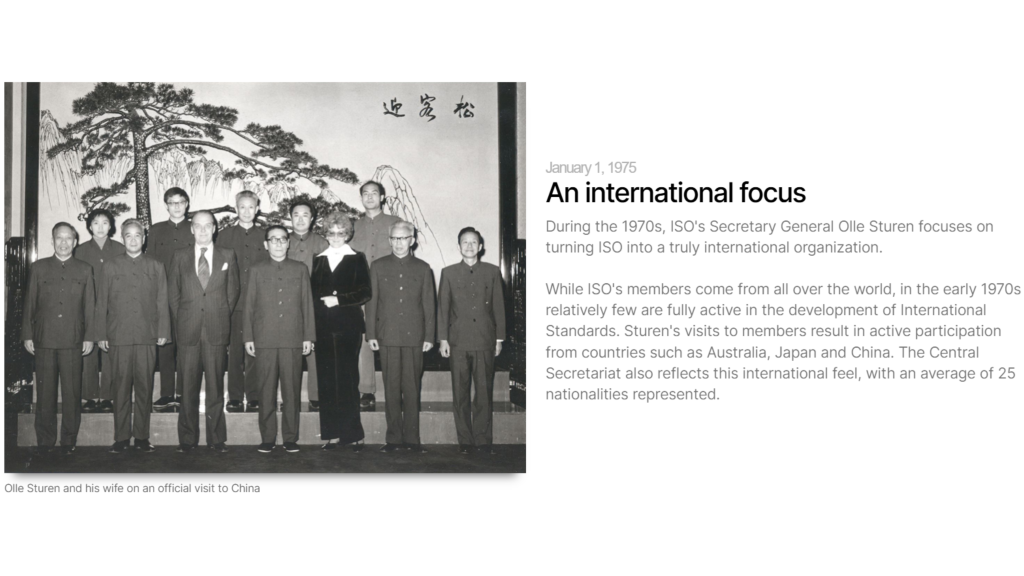
In 1969 (January 1, 1969), Olle Sturen became Secretary-General of ISO. In one of his first speeches, he stated that International Standardization was the end of 'technical nationalism'.
Contact our nearest office for a detailed explanation of the certification scheme and procedures.
The TNVID Certification Body has been instrumental in helping us achieve our management system certification goals. Their robust certification and foundational training, along with exceptional readability, ensure the stability of our management system. (Lembaga Sertifikasi TNVID telah berperan penting dalam membantu kami mencapai tujuan sertifikasi sistem manajemen kami. Sertifikasi yang kuat dan pelatihan dasar mereka, bersama dengan kemudahan pembacaan yang luar biasa, memastikan stabilitas sistem manajemen kami.)
